
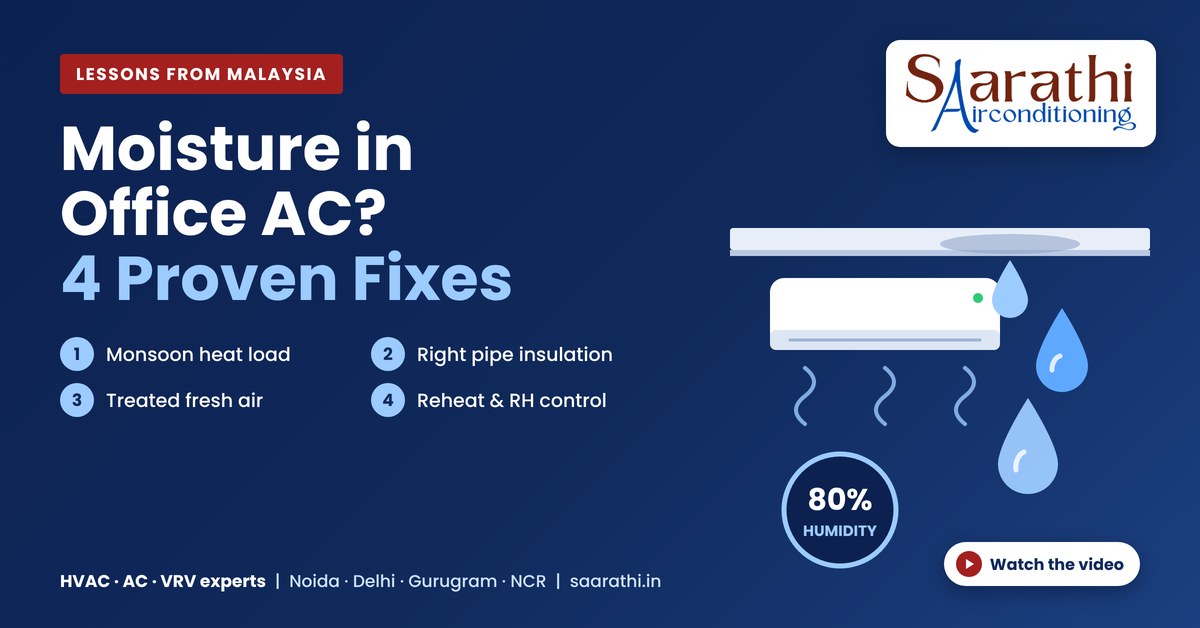
Moisture Problems in Office AC? 4 Proven Fixes We Explained from Malaysia
Quick answer: Moisture in an office AC system (dripping ceilings, damp smell, fungus, fogged glass) is a design and installation problem, not a cooling problem. Four things control it: a heat load calculated for monsoon conditions, insulation of the specified thickness on every pipe, fresh air that is treated before it enters, and reheat with RH control for critical areas like clean rooms and hospitals.
By Pankaj Nirman, Co-founder, Saarathi Projects. 18+ years in HVAC design and installation across Delhi NCR.
I recorded this video in Kuala Lumpur, Malaysia, where humidity stays high almost every day of the year. It is the right place to talk about a problem we see in Delhi, Noida and Gurugram every monsoon: moisture that the AC system cannot control.
When moisture is not handled, it damages false ceilings, causes fungus and musty smells, and can harm sensitive equipment. Most clients ask for a bigger AC. That rarely helps, and often makes it worse.
The four factors below come from our own HVAC projects at hospitals such as Max Hospitals, Safdarjung Hospital and AIIMS, and from offices across NCR where we kept moisture under control through the monsoon.
Signs your AC has a moisture problem
- Water dripping from the false ceiling, ducts or AC pipes
- Musty or damp smell in cabins and meeting rooms
- Black fungus spots on gypsum or grid ceiling tiles
- Glass partitions or windows that fog up
- The room feels cold but sticky (clammy)
1. Why must the heat load be calculated for monsoon conditions?
A heat load calculation has two sets of design conditions: summer and monsoon. Many systems are designed only for the summer peak. In the monsoon the outdoor temperature drops, but moisture in the air rises sharply, so the AC must remove water (latent load) as well as heat (sensible load).
An AC sized only for summer, or oversized, cools the room fast and cycles off before it removes enough moisture. The space ends up cold and clammy, and fixing it later costs more than designing it right. Always design for both summer and monsoon.
2. How does poor insulation cause water dripping from the ceiling?
Refrigerant suction lines and condensate drain pipes run colder than the air around them. Any bare joint, bend or gap will sweat, and that water lands on your false ceiling.
The common shortcuts we see: 13 mm or 19 mm insulation used where 25 mm is specified, poor adhesive, weak taping and incomplete covering. Once the insulation catches moisture, it stops working. Never compromise on insulation thickness or finishing.
3. How should fresh air enter an air-conditioned office?
Offices need fresh air, but humid outdoor air that enters directly carries moisture straight into the space. There are two right ways to bring it in:
- Supply treated fresh air (TFA) through a dedicated fresh-air unit, or
- Duct the fresh air directly to the filter of the AHU or ductable unit, so it is cooled and dried before it reaches the room.
Keeping the space at slight positive pressure also stops untreated air from creeping in through doors and gaps.
4. When do you need reheaters and RH control?
In clean rooms, operation theatres, labs and other critical spaces, the first three steps may still not hold the relative humidity (RH) you need, for example 40%. There we add reheaters and dehumidifiers with a control panel to reach and hold the target RH.
The trade-off is energy: the heater and the cooling system run together, so power use is higher. That is why we design reheat only where the application needs it, not for normal offices.
Video chapters
- 0:00 Intro from Kuala Lumpur
- 0:36 Our experience: hospitals and offices
- 1:16 Factor 1: Heat load for monsoon
- 1:40 Factor 2: Insulation
- 2:12 Factor 3: Blocking untreated fresh air
- 2:43 Factor 4: Heaters and RH control
- 3:28 Recap
Watch the full video on YouTube: How to Control Moisture and Humidity in Office AC
Key takeaways
| Problem | Cause | Fix |
|---|---|---|
| Cold but clammy room | AC sized for summer only, or oversized | Heat load for monsoon (latent + sensible) |
| Water dripping from ceiling | Thin or badly finished pipe insulation | Specified thickness (e.g. 25 mm), sealed joints, insulated drain |
| Damp smell, fungus | Untreated humid fresh air | TFA unit or fresh air ducted to AHU filter |
| RH drifting in OT / clean room | No RH control | Reheaters + dehumidifiers with control panel |
Frequently asked questions
Will a bigger AC fix the humidity in my office?
Usually not. An oversized AC short-cycles and removes less moisture. Correct sizing for the monsoon latent load is what fixes humidity.
Why is water dripping from my AC pipes or false ceiling?
Most often it is condensation on poorly insulated refrigerant or drain pipes, or a blocked drain line. A site check finds the exact point.
What insulation thickness should AC pipes have?
Use the thickness the design specifies for that pipe size and location, commonly 19 mm to 25 mm closed-cell insulation, with every joint sealed and taped. Thinner insulation to save cost is a common cause of dripping.
What is treated fresh air (TFA)?
TFA is outdoor air that is filtered, cooled and dehumidified by a dedicated unit before it is supplied to the rooms, so fresh air does not add moisture.
Do normal offices need reheaters?
Rarely. Reheat is for spaces with strict RH limits, such as clean rooms, operation theatres, labs and pharma areas, because it raises energy use.
Can VRV/VRF systems control humidity?
VRV/VRF systems handle cooling and some dehumidification well. In humid seasons, pair them with a TFA unit and correct insulation for reliable moisture control.
Who can fix AC moisture problems in Noida, Delhi or Gurugram?
Saarathi Projects designs, supplies, installs and services HVAC and VRV systems across Delhi NCR, with offices in Noida (Sector 16) and Delhi (Bhajanpura). We offer a free site survey.
Get moisture-free AC for your office, hospital or clean room in Delhi NCR
Saarathi Projects is an HVAC, air conditioning and VRV/VRF company serving Noida, Delhi, Gurugram and the wider NCR for 18+ years. We design, supply, install and maintain systems for offices, hospitals, retail and industry, with 125+ corporate clients and 3,000+ units under AMC.
If your ceiling drips, your office smells damp or your OT can’t hold its RH, we will find the cause and fix it at the design level.
Book a free site survey: call +91-98910 01461, email pankaj@saarathi.in, or get a free quote.
Offices: A-55, Sector 16, Noida 201301 · D-384/9B, Bhajanpura, Delhi 110053